
Stop Coding, Start Vibe Coding: Meet the Candor
The Problem We All Face
We've all been there.
You have a critical business question, but the answer is scattered across multiple systems: SaaS platforms, databases, and spreadsheets that don't talk to each other.
Getting to that answer isn't simple.
Traditionally, it means building an ETL pipeline. That involves writing complex SQL queries, understanding APIs, configuring orchestration tools, and spending hours debugging issues like schema mismatches or failed transformations.
It's slow. It's complex. And it requires specialized skills just to access the data you already have.
So the question is: Why is this still so hard?
A New Approach: From Coding to Vibe Coding
The answer lies in changing the approach itself.
Instead of writing pipelines step by step, what if you could simply describe what you need?
This is where vibe coding comes in.
With Candor, you don't write code. You define intent.
You describe your data requirement in plain English, and the platform generates the entire pipeline for you.
This isn't just automation, it's intelligence. The system understands context, interprets requirements, and builds production-ready pipelines automatically.
Not Just Another Coding Tool
Traditional tools can generate code. But they don't understand your data.
They rely on prompts, guesses, and repeated corrections.
Candor is different. It's built specifically for data workflows, not generic code generation.
Introducing Candor
Candor is built around an Agentic AI architecture that transforms how data pipelines are created and executed.
At its core, Candor eliminates manual data engineering by combining:
- Prompt-based pipeline generation
- Schema-aware processing
- AI-driven logic synthesis
- Intelligent orchestration
The result is a system where ideas turn into working pipelines in minutes, not weeks.
From Prompt to Pipeline: How It Works
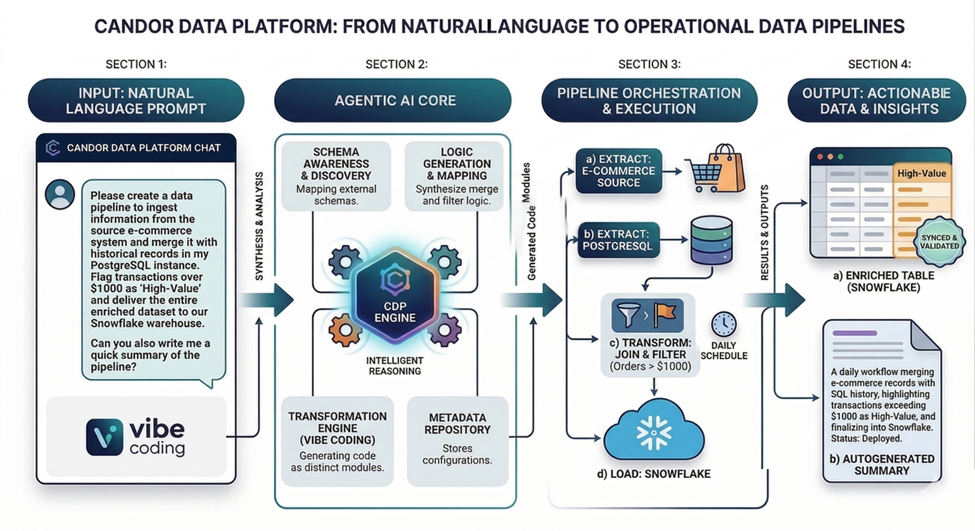
1. Natural Language Prompt
Everything starts with a simple instruction.
Instead of writing code, the user describes the requirement in plain language. For example, combining e-commerce data with a PostgreSQL database, identifying high-value customers, and loading the results into Snowflake.
No scripts. No configurations. Just intent.
2. Agentic AI Core
This is where the transformation happens.
The platform's intelligence engine analyzes the prompt and breaks it down into actionable steps. It automatically scans connected systems to understand schemas and relationships.
Using this context, it generates the required logic, merging datasets, applying filters, and structuring transformations. This is what enables vibe coding, where the system writes the pipeline for you.
3. Pipeline Orchestration and Execution
Once the logic is generated, the platform builds and executes the pipeline.
Data is extracted from the defined sources, transformed according to the generated logic, and loaded into the target system. The entire workflow is orchestrated automatically, without manual intervention.
What traditionally required multiple tools and configurations is handled within a single flow.
4. Actionable Data and Insights
The final output is not just data, it's validated, structured, and ready for use.
The platform ensures that the pipeline aligns with the original intent and provides a clear summary of how the data was processed. This gives users both confidence and transparency.
Why This Changes Everything
The traditional approach to data engineering is built around code. Candor shifts that model to intent-driven execution.
Instead of spending time writing and debugging pipelines, teams can focus on what actually matters: understanding data and driving decisions.
This leads to:
- Faster pipeline development
- Reduced engineering effort
- Fewer errors
- Greater accessibility for non-engineers
Candor vs Traditional Tools: A Quick Comparison
| Feature | Traditional Vibe Coding Tools | Candor |
|---|---|---|
| Core Purpose | General code generation | Built for data workflows and pipelines |
| Data Understanding | No schema awareness | Deep schema-aware intelligence |
| Context Awareness | Limited (depends on prompt) | Understands full data context |
| Workflow Support | Fragmented | End-to-end pipeline support |
| Automation | Manual prompting required | AI-Powered pipeline generation |
| Accuracy | Trial and error | More precise, data-driven output |
| Speed | Slower (iterations needed) | Faster from data to insight |
| User Effort | High (constant corrections) | Low (guided and structured) |
| Scalability | Hard to scale workflows | Designed for large data systems |
| Use Case Fit | Generic development tasks | Real-world data engineering use cases |
| Integration with Data Systems | Limited | Built for data platforms |
| Business Value | Code output only | Insights + workflows + automation |
The Future of Data Engineering
We are moving toward a world where systems don't just assist developers, they understand them.
Vibe coding represents this shift.
It allows users to move from idea to execution without being blocked by technical complexity. As data continues to grow in scale and importance, this kind of approach will define how modern data platforms operate.
Conclusion
The old way of building ETL pipelines required time, effort, and deep technical expertise.
The new way requires clarity of intent.
Candor brings this shift to life by enabling users to build, execute, and manage data pipelines through simple prompts.
No complex coding. No fragmented tools. Just a faster, smarter way to work with data.
The Future is Curated Intelligence
- The next wave is not about generating more code
- It's about curating the right data, workflows, and outcomes
Candor leads that shift.